
 Posts
Posts


 Let's be honest: Grey's Anatomy is dying. Slowly, but is happening.
First there was the TR Knight/Isaiah Washington incident, which shook the world to its very core and proved just what a badass Patrick Dempsy really is followed by the rumors that Katherine Heigl was going to be taken off the show for being annoying both on and off screen. Then, Brooke Smith was unceremoniously fired from the show last November, just when her story line was getting interesting. And now comes the rumor that T.R. Knight has asked to be released from his contract. This isn't much of a surprise to anyone who watches the show and, like me, noticed to severe lack of George O'Malley.
The point is, we're reaching that moment when viewers of a once-popular show forget why they ever watched it in the first place and simply stop. Sure, the diehard fans will stick around, but doing this takes a kind of dedication apparently not found in the average Nielsen family.
Yes, it seems Grey's on its way out. And sure, while it's upsetting that we'll no longer be privy to the trials and tribulations of Seattle Grace's oddly sexual doctors, viewers can take solace in the fact that this might lead to the best last season ever.
And all of this has to do with a little theory I like to call "Good, Bad, Awesome."
Good, Bad, Awesome is a phenomena I've noticed in shows that start out red-hot, but slowly fade out of public conscious. This is currently happening with the downward spiral of Heroes. No one is watching, but they're bringing Bryan Fuller in to straighten things out.
The OC, for example started insane, but soon fizzled and was forgotten and hated by those who once considered themselves fans. What those who stopped watching missed out on was an amazing forth and final season.
LOST is another example of a show that started with amazing buzz, but got too slow and "kooky" for some viewers. What these poor saps missed out on is was the amazing last two seasons. And Sayid braking someone's neck with his feet.
SCRUBS, was quirky and original show that faught for ratings and viewers, only to slowly fade quietly into NBC's Thursday nights lineup. This show was even canceled, only to be saved by ABC, giving it a promising-looking last(?) season.
Now, the "Good, Bad, Awesome" theory doesn't always but if the Grey's team manages to get back to what is was that made the show good in the first place we could be in for an amazing, if final season in a couple of years.
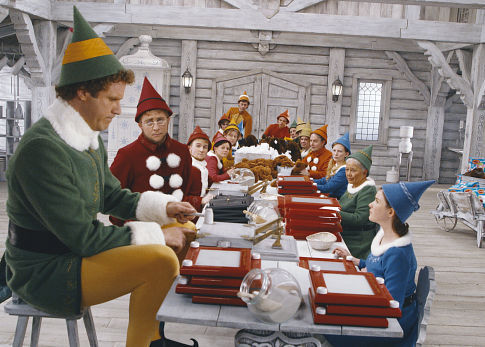
But recently I got pissed at Christmas movies. Now obviously you can't throw a huge amount of criticism at Christmas movies. They have all the wonder and the magic and the Christmas spirit stuff for family fare. But there's a huge almost universal theme in Christmas films in the way that they represent Santa's workshop, and I constantly find myself distracted by it, taking me out of the otherwise enchanting experience that comes from Christmas movies.
I don't mind that Santa's workshop looks like an old-fashioned sort of workshop, or anything coming from production design that truly separates the North Pole from any other place on the planet. My beef stems from the fact that the toys that we generally see the elves making and packing up to send of to boys and girls around the world are from the 1920's. Mechanical drumming monkeys, porcelain figures, handwoven dolls, etc. These aren't necessarily awful in every sense, because at some point in time these were real toys for children. But for today I think that Santa's workshop products should be a little more representative of the times.
This is where I give one film a huge amount of praise not only for quickly becoming a modern Christmas classic, but for it's realistic portrayal of the toy culture of today's children. Jon Favreau's Elf has all the signature traits of the North Pole and Santa's workshop and then some ("Thanks, Mr. Narwhal"). But one key element is subtle but strikes me as brilliance. Nearly all of the toys within Santa's workshop are real and at least somewhat popular toys sold in stores today. Monopoly, Etch-a-Sketch, even a Bob the Builder doll are all part of the elves product line, and I think, especially for kids, this makes the magic of Santa Claus and the Christmas movie all the more magical. Whereas in The Santa Clause (Tim Allen) this workshop does nothing but manufacture antique toys to fit along with their old-fashioned, carefully crafted classic world, but they still have the means and know-how to add all these technological upgrades to Santa's suit and sleigh, but not know that a kid wants an iPod for Christmas.
My Dad made the commercial observation to me that the reason that happened, is because those are the companies that paid enough to get their product in the movie. And as cynical as that is, it's definitely correct. But product placement is something that happens anyway, and happens in mostly every film, so why not place it in a movie that's perfect for product placement, and have it truly fit in as part of a movie and not a "Well, I know James Bond loves Coca-Cola! Especially after having sex with a lady!"
All I know is that, despite Christmas movies not necessarily being a great source for realistic representations of the world, I think that it adds to the whimsical nature of the Christmas movie for kids and adults alike.
MeanRider is a regular installment of The Screen Rider and is basically an editorial piece on various loves and hates of different aspects of film and television. They are meant to critique, and provoke thought amongst the pop culture community